
So, are you gearing up for your practical driving test in Germany? You’ve put in the hours, mastered the manoeuvres, and probably even dreamt about parallel parking. But at Fahrschule Abgefahrn, we’ve seen it all. And trust us, some mistakes pop up time and time again, turning hopeful smiles into disappointed frowns.
We’re not talking about hypothetical blunders here. These are the real-world, statistically-backed, instructor-verified errors that lead students to fail their test. We’re about to pull back the curtain on the Top 10 Deadly Driving Test Mistakes so you can be armed with the knowledge to avoid them. Because, let’s face it, nobody wants to retake their test!
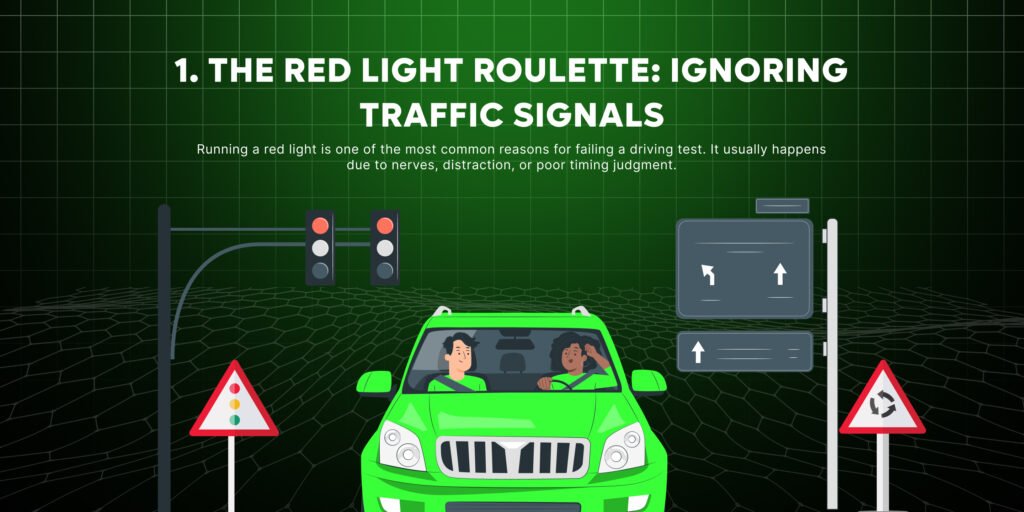
1. The Red Light Roulette: Ignoring Traffic Signals
Running a red light might seem like a simple mistake, but it’s one of the biggest reasons people fail their driving test. It usually happens when learners are nervous, distracted, or misjudge the timing.
But there are no second chances with this one; if you drive through a red light, you fail right away. It’s not just about the test either. You could hit another car or a pedestrian. That’s why it’s so important to stay focused. Always keep your eyes on the lights and be ready to stop. Don’t let nerves or traffic pressure make you miss something so serious.
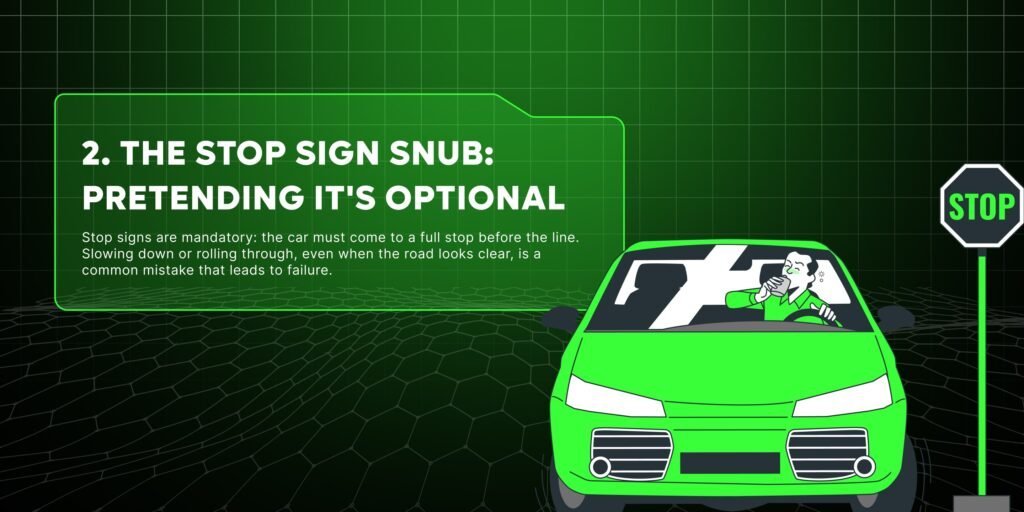
2. The Stop Sign Snub: Pretending it's Optional
Just like red lights, stop signs are non-negotiable. A “stop” means a complete and total halt, with your vehicle motionless before the stop line. Not a rolling stop, not a quick glance and go. We’re talking zero kilometres per hour. Many learners make the mistake of slowing down significantly but not coming to a complete stop, especially if they perceive no cross-traffic.
Your examiner, however, is very attentive and will quickly notice this mistake. It’s not just a subtle detail; it’s a key safety rule. Stop signs are positioned at intersections where visibility is poor or where collisions are more likely. Ignoring them shows you haven’t properly assessed the situation, which is a basic flaw in your driving. By tracking a step-by-step guide, you can learn to recognize every stop sign and ensure no important point is overlooked.
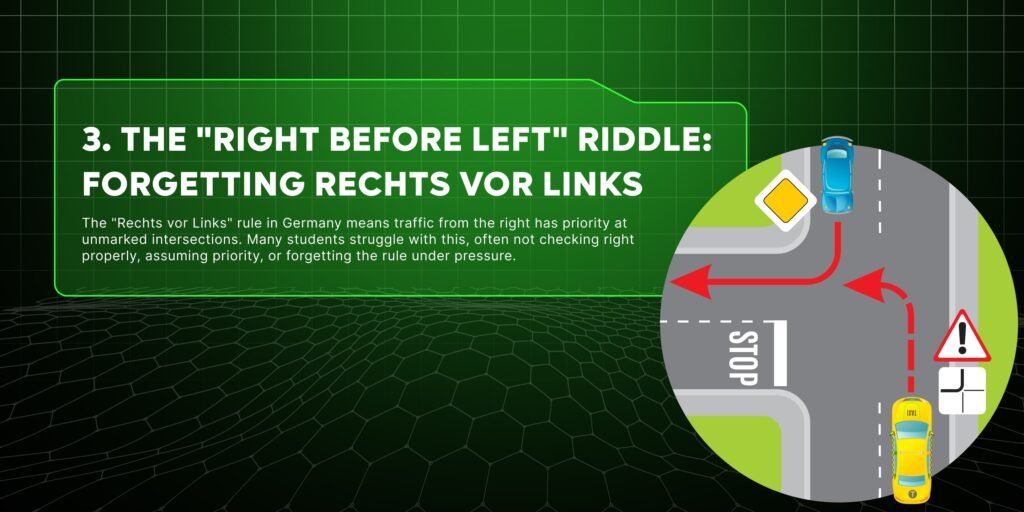
3. The "Right Before Left" Riddle: Forgetting Rechts vor Links
Ah, the infamous “Rechts vor Links” rule. This one trips up more students than you’d think, even those who’ve practised diligently. In Germany, at unmarked intersections, traffic coming from the right has the right of way. It’s a fundamental principle of road traffic. Candidates often fail to yield because they’re either not looking thoroughly enough to their right, they assume they have the right of way, or they simply forget the rule in the heat of the moment.
We’ve seen situations where a student confidently drives into an intersection, unaware of a car approaching from the right. This results in a dangerous braking manoeuvre by the examiner to avoid a collision. This mistake demonstrates a lack of understanding of basic traffic rules and a potential for creating hazardous situations. Always, always check both left and right, and remember: if there are no signs or signals, the person on your right goes first!
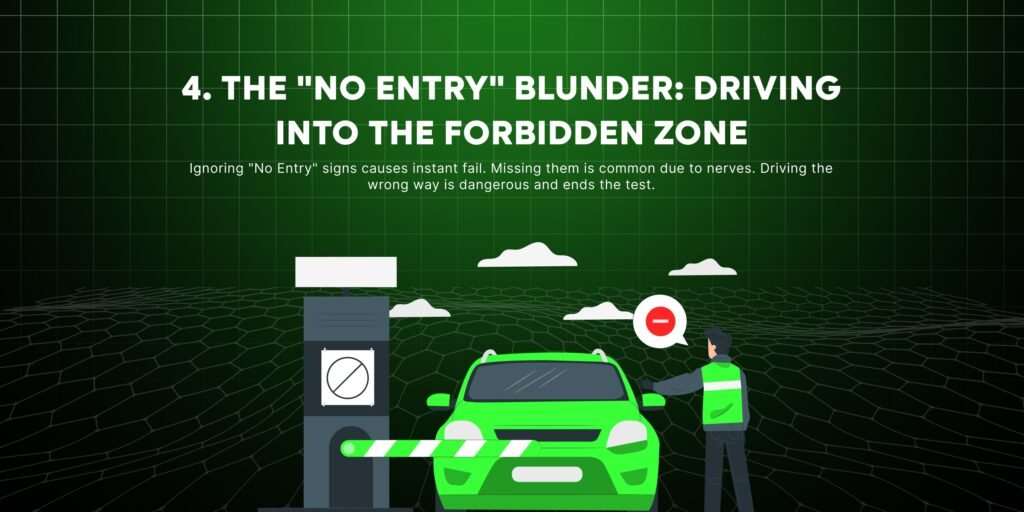
4. The "No Entry" Blunder: Driving into the Forbidden Zone
Seeing a “No Entry” sign (the red circle with a white horizontal bar) and driving straight past it is an instant fail. This isn’t a suggestion; it’s an absolute prohibition. These signs are placed for very good reasons, often indicating one-way streets, pedestrian zones, or areas where entering would lead to immediate danger (like driving against traffic).
Students sometimes miss these signs due to distraction, poor observation skills, or simply not understanding the sign’s meaning in their test nerves. Imagine driving the wrong way down a busy street in Düsseldorf; it’s hazardous and puts everyone at risk. Your examiner will hit the brakes, and your test will be over.
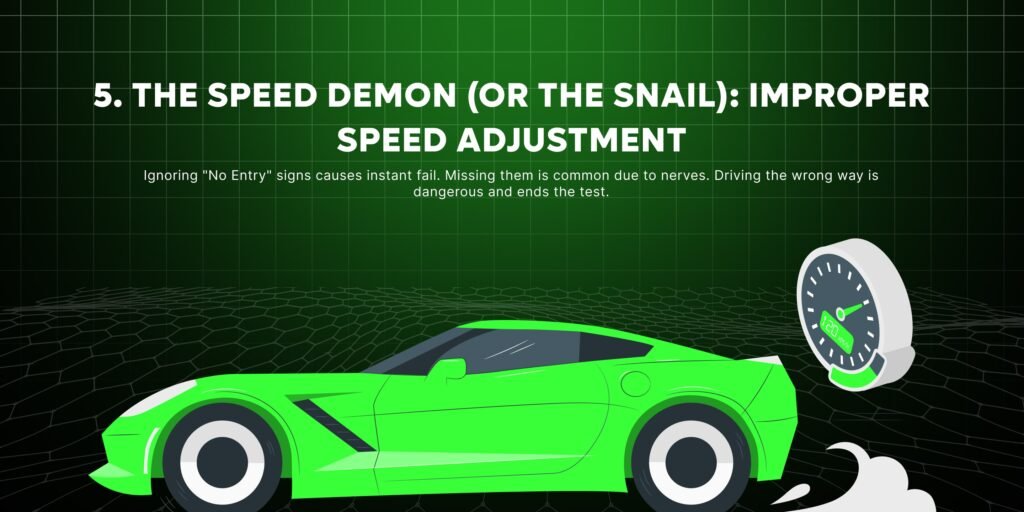
5. The Speed Demon (or the Snail): Improper Speed Adjustment
This isn’t just about outright speeding. While exceeding the speed limit is certainly a test-ender, equally problematic is driving too slowly without cause, or failing to adjust your speed to the prevailing conditions. Driving too slowly can impede traffic flow and frustrate other drivers, creating potentially dangerous situations.
On the flip side, driving too fast for the conditions, whether it’s heavy rain, poor visibility, or narrow residential streets, shows a lack of judgment and risk assessment. Your examiner is looking for a driver who can maintain an appropriate and safe speed for the environment. For example, speeding through a 30 km/h zone near a school, or crawling along at 30 km/h on a clear 50 km/h road, both indicate you’re not fully understanding the nuances of safe driving. It’s about being in harmony with the road, not fighting against it.
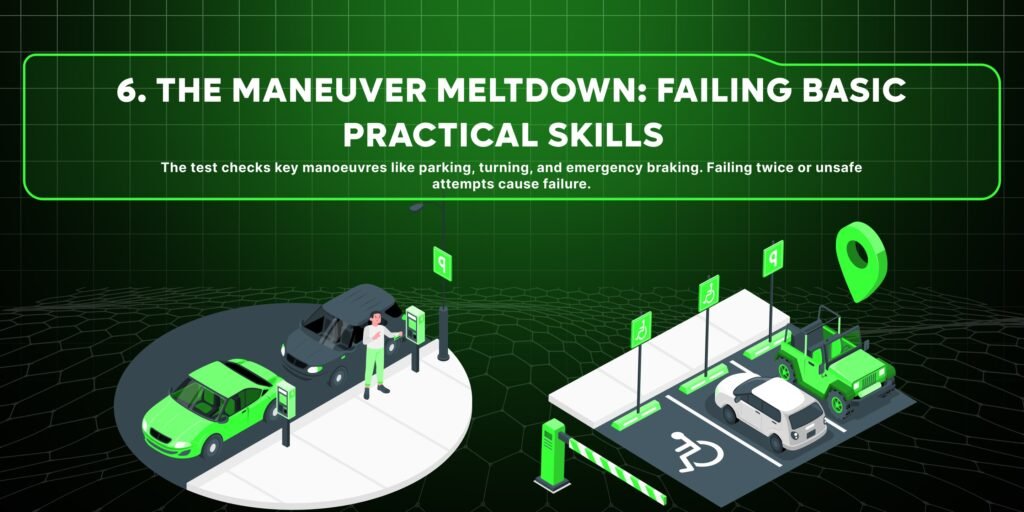
6. The Maneuver Meltdown: Failing Basic Practical Skills
The practical test isn’t just about driving from point A to point B. It’s also about demonstrating your mastery of essential manoeuvres. These include parking (parallel, reverse, or forward into a bay), turning around (three-point turn or reversing around a corner), and emergency braking. While you often get two attempts for these, failing them both or performing them in a way that is unsafe or shows a complete lack of control will lead to failure.
Students often get nervous and rush these manoeuvres, forgetting the steps or becoming clumsy. Forgetting to check your blind spots while parking, hitting the curb repeatedly during a turnaround, or not reacting decisively during an emergency brake simulation all highlight a fundamental lack of control over the vehicle. Practice these until they are second nature, even under pressure.
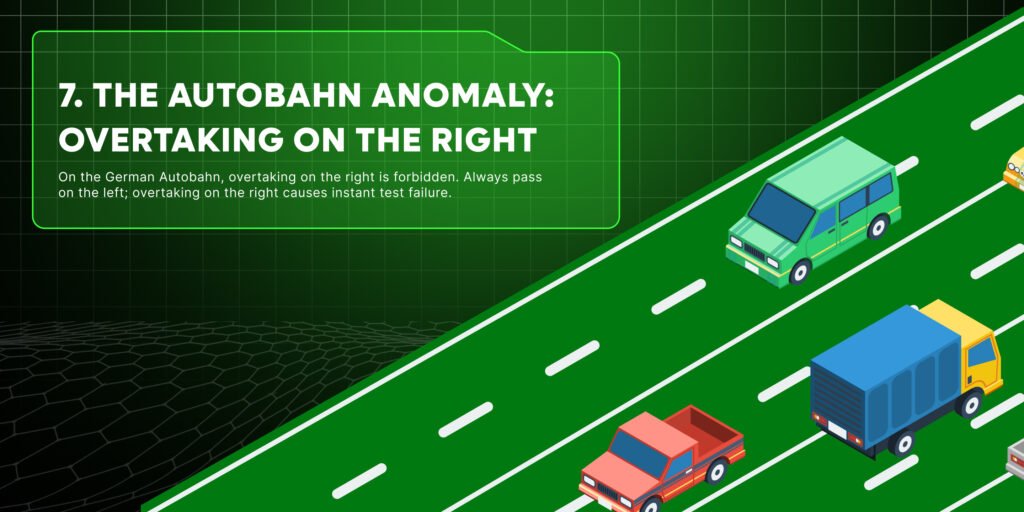
7. The Autobahn Anomaly: Overtaking on the Right
The German Autobahn is famous for its lack of speed limits in some sections, but it also has stringent rules. One of the most critical is the prohibition of overtaking on the right. In Germany, you must always overtake on the left. Driving past a vehicle on its right on a multi-lane Autobahn is a serious offence and an immediate test failure.
We’ve seen students do this out of habit from other countries, or simply because they see an open lane and take it without thinking. This rule is designed to maintain predictable traffic flow and prevent dangerous situations at high speeds. Ignoring it demonstrates a fundamental misunderstanding of high-speed road rules.
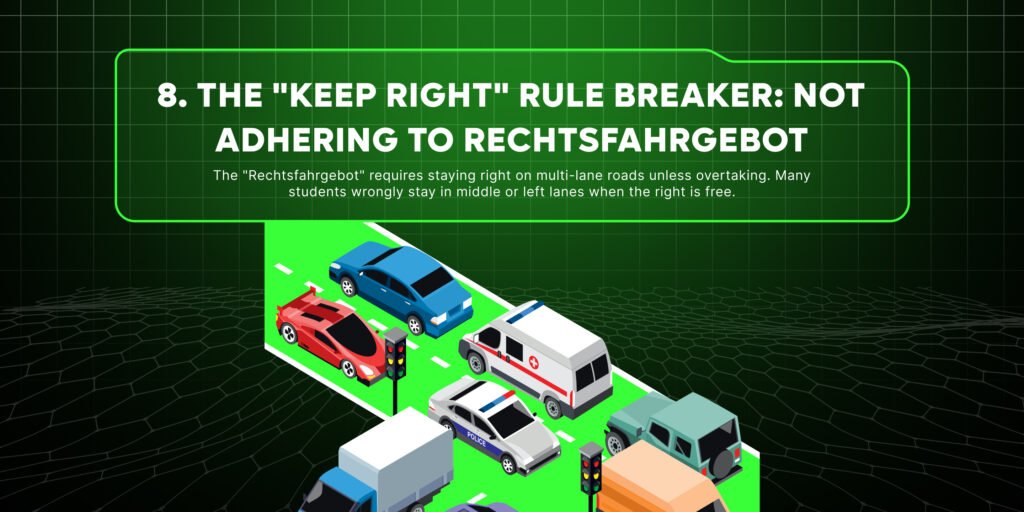
8. The "Keep Right" Rule Breaker: Not Adhering to Rechtsfahrgebot
Closely related to Autobahn rules is the “Rechtsfahrgebot”, the requirement to keep as far right as possible on multi-lane roads, unless overtaking or encountering an obstacle. Many students, especially on multi-lane city roads or the Autobahn, tend to stay in the middle or left lane even when the right lane is free.
This not only clogs up the faster lanes but is also against the law and will be noted by your examiner. It shows a lack of awareness of traffic flow principles and proper lane discipline. It might seem minor, but it’s a core tenet of efficient and safe driving in Germany. Get used to always returning to the rightmost lane after an overtaking manoeuvre.
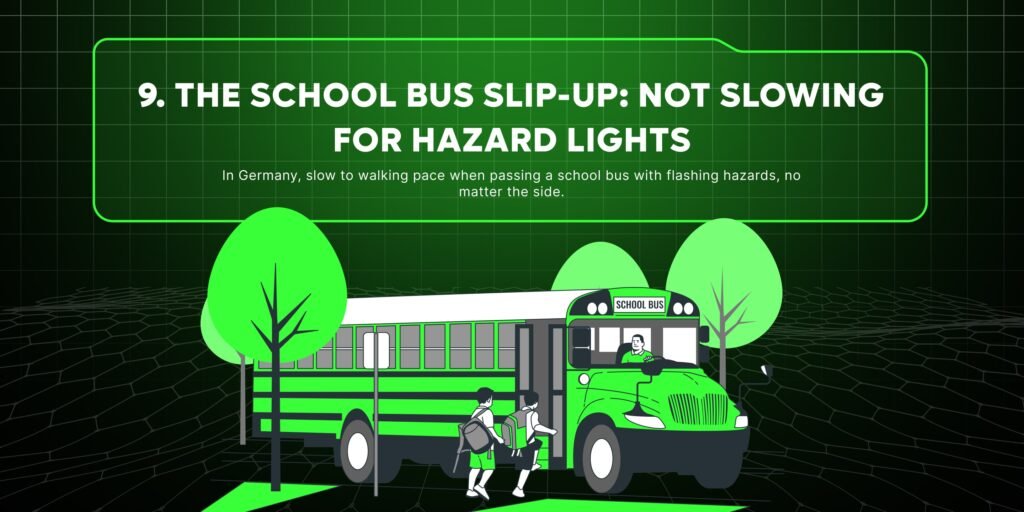
9. The School Bus Slip-Up: Not Slowing for Hazard Lights
This is a very specific but extremely important rule in Deutschland: when you encounter a school bus with its hazard lights flashing, you must reduce your speed to walking pace when passing it. This applies whether the bus is stopping to let children on or off, and regardless of whether it’s on your side of the road or the opposite side.
This rule is in place to protect children who might unexpectedly run into the street. Driving candidates often miss this important rule, either driving past at their usual speed or not slowing down enough. It’s a clear indicator of a lack of attention to vulnerable road users and a disregard for specific safety regulations. Your examiner will be keenly observing your reaction to such situations.
10. The Blinking Blunder: Failing to Stop for a Left-Turn Signal
This is another subtle but critical mistake that often catches students off guard. When a left-turn signal (a green arrow pointing left) is blinking, it means you have priority to turn left, but you must still come to a full stop before entering the intersection if there’s opposing traffic or pedestrians to yield to before completing your turn.
Many drivers or test candidates see the blinking arrow and assume it means they can just go without stopping, leading to dangerous encounters with oncoming traffic or pedestrians. The blinking arrow grants you the right of way for your turn, but it doesn’t exempt you from exercising caution and ensuring the path is clear after your stop. It’s about combining your right of way with responsible observation. Failing to make that initial stop shows a fundamental misunderstanding of safe intersection navigation.
Your Path to Success Starts Here!
Feeling a little overwhelmed? Don’t be! The purpose of sharing these common mistakes isn’t to scare you, but to empower you. Knowledge is power, and by understanding where others tend to falter, you can proactively avoid these pitfalls.
At Fahrschule Abgefahrn, we don’t just teach you how to drive; we focus on making you a safe, confident, and smart driver. A great driving school is built on many important factors and qualities, and our experienced instructors are experts at spotting and fixing common mistakes. We make sure you’re completely ready for your test.
So, take a deep breath, review these points, and most importantly, keep practicing! Your driving license is within reach.